17 sickles to a galleon and 29 knuts to a sickle seems like a pretty confusing system for a community of people who stop learning maths at the age of eleven
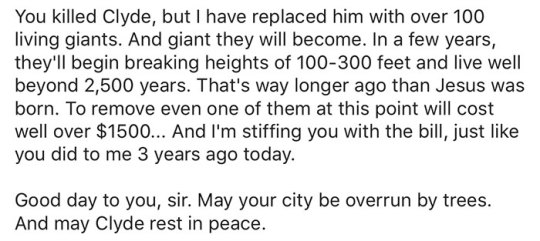
This is one of the best stories we read in a long time. An arborist AKA a tree caretaker and tree surgeon from Redondo Beach, California had to watch the death of one of his favorite trees, which was ordered by the mayor. Although he lost a great battle, he won the war. Find out how he avenged the death of his 30-year-old pepper tree named Clyde.
His story was recently shared online and has already been shared over 150k times. RIP Clyde.
Open a bank account or get a credit card without signed permission from her father or hr husband.
Serve on a jury – because it might inconvenience the family not to have the woman at home being her husband’s helpmate.
Obtain any form of birth control without her husband’s permission. You had to be married, and your hub and had to agree to postpone having children.
Get an Ivy League education.
Ivy League schools were men’s colleges ntil the 70′s and 80′s. When
they opened their doors to women it was agree that women went there for
their MRS. Degee.
Experience equality in the workplace: Kennedy’s
Commission on the Status of Women produced a report in 1963 that
revealed, among other things, that women earned 59 cents for every
dollar that men earned and were kept out of the more lucrative
professional positions.
Keep her job if she was pregnant.Until the Pregnancy Discrimination Act in 1978, women were regularly fired from their workplace for being pregnant.
Refuse to have sex with her husband.The mid 70s saw most states recognize marital rape and in 1993 it became criminalized
in all 50 states. Nevertheless, marital rape is still often treated
differently to other forms of rape in some states even today.
Get a divorce with some degree of ease.Before the No Fault Divorce
law in 1969, spouses had to show the faults of the other party, such as
adultery, and could easily be overturned by recrimination.
Have a legal abortion in most states.The Roe v. Wade case in 1973 protected a woman’s right to abortion until viability.
Take legal action against workplace sexual harassment.
Play college sports
Title IX of the Education
Amendments of protects people from discrimination based
on sex in education programs or activities that receive Federal
financial assistance
It was nt until this statute that colleges had teams for women’s sports
Apply for men’s Jobs
The EEOC rules that
sex-segregated help wanted ads in newspapers are illegal. This ruling
is upheld in 1973 by the Supreme Court, opening the way for women to
apply for higher-paying jobs hitherto open only to men.
This is why we needed feminism – this is why we know that feminism works
I just want to reiterate this stuff, because I legit get the feeling there are a lot of younger women for whom it hasn’t really sunk in what it is today’s GOP is actively trying to return to.
Did you go to a good college? Shame on you, you took a college placement that could have gone to a man who deserves and needs it to support or prepare for his wife & children. But if you really must attend college, well, some men like that, you can still get married if you focus on finding the right man.
Got a job? Why? A man could be doing that job. You should be at home caring for a family. You shouldn’t be taking that job away from a man who needs it (see college, above). You definitely don’t have a career – you’ll be pregnant and raising children soon, so no need to worry about promoting you.
This shit was within living memory.
I’M A MILLENIAL and my mother was in the second class that allowed women at an Ivy League school.
Men who are alive today either personally remember shit like this or have parents/family who have raised them into thinking this was the way America functioned back in the blissful Good Old Days. There are literally dudes in the GOP old enough to remember when it was like this and yearn for those days to return.
When people talk about resisting conservativism and the GOP, we’re not just talking about whether the wage gap is a myth or not. We’re talking about whether women even have the fundamental right to exist as individuals, to run their own households and compete for jobs and be considered on an equal footing with men in any arena at all in the first place.
I was a child in the 1960s, a teenager in the 1970s, a young adult in the 1980s. This is what it was like:
When I was growing up, it was considered unfortunate if a girl was good at sports. Girls were not allowed in Little League. Girls’ teams didn’t exist in high school, except at all-girls’ high schools. Boys played sports, and girls were the cheerleaders.
People used to ask me as a child what I wanted to be when I grew up. I said I wanted to be a brain surgeon or the first woman justice on the Supreme Court. Everyone told me it was impossible–those just weren’t realistic goals for a girl–the latter, especially, because you couldn’t trust women to judge fairly and rationally, after all.
In the 1960s and 1970s, all women were identified by their marital status, even in arrest reports and obituaries. In elementary school, my science teacher referred to Pierre Curie as DOCTOR Curie and Marie Curie as MRS. Curie…because, as he put it, “she was just his wife.” (Both had doctorates and both were Nobel prize winners, so you would think that both would be accorded respect.)
Companies could and did require women to wear dresses and skirts. Failure to do could and did get women fired. And it was legal. It was also legal to fire women for getting married or getting pregnant. The rationale was that a woman who was married or who had a child had no business working; that was what her husband was for. Aetna Insurance, the biggest insurance company in America, fired women for all of the above.
A man could rape his wife. Legally. I can remember being twelve years old and reading about legal experts actually debating whether or not a man could actually be said to coerce his wife into having sex. This was a serious debate in 1974.
The debate about marital rape came up in my law school, too, in 1984. Could a woman be raped by her husband? The guys all said no–a woman got married, so she was consenting to sex at all times. So I turned it around. I asked them if, since a man had gotten married, that meant that his wife could shove a dildo or a stick or something up his ass any time she wanted to for HER sexual pleasure.
(Hey, I thought it was reasonable. If one gender was legally entitled to force sex on the other, then obviously the reverse should also be true.)
The male law students didn’t like the idea. Interestingly, they commented that being treated like that would make them feel like a woman.
My reaction was, “Thank you for proving my point…”
The concept of date rape, when first proposed, was considered laughable. If a woman went out on a date, the argument of legal experts ran, sexual consent was implied. Even more sickening was the fact that in some states–even in the early 1980s–a man could rape his daughter…and it was no worse than a misdemeanor.
Women taking self-defense classes in the 1970s and 1980s were frequently described in books and on TV as “cute.” The implication was that it was absurd for a woman to attempt to defend herself, but wasn’t it just adorable for her to try?
I was expressly forbidden to take computer classes in junior and senior years of high school–1978-79 and 1979-80–because, as the principal told me, “Only boys have to know that kind of thing. You girls are going to get married, and you won’t use it.”
When I was in college–from 1980 to 1984–there were no womens’ studies. The idea hadn’t occurred in many places because the presumption was that there was nothing TO study. My history professor–a man who had a doctorate in history–informed me quite seriously that women had never produced a noted painter, sculptor, composer, architect or scientist because…wait for it…womens’ brains were too small.
(He was very surprised when I came up with a list of fifty women gifted in the arts and science, most of whom he had never heard of before.)
When Walter Mondale picked Geraldine Ferraro as a running mate in 1984, the press hailed it as a disaster. What would happen, they asked fearfully, if Mondale died and Ferraro became president? What if an international crisis arose and she was menstruating? She could push the nuclear button in a fit of PMS! It would be the end of the WORLD!!
…No, they WEREN’T kidding.
On the surface, things are very different now than they were when I was a child, a teen and a young adult. But I’m afraid that people now do not realize what it was like then. I’ve read a lot of posts from young women who say that they are not feminists. If the only exposure to feminism they have is the work of extremists, I cannot blame them overmuch.
I wish that I could tell them what feminism was like when it was new–when the dream of legal equality was just a dream, and hadn’t even begun to come true. When “woman’s work” was a sneer–and an overt putdown. When people tut-tutted over bright and athletic girls with the words, “Really, it’s a shame she’s not a boy.” That lack of feminism wasn’t all men opening doors and picking up checks. A lot of it was an attitude of patronizing contempt that hasn’t entirely died out, but which has become less publicly acceptable.
I wish I could make them feel what it was like…when grown men were called “men” and grown women were “girls.”
Know your history.
So this, too, is what they mean saying “make America great again” and/or the good old days.
REBLOG FOREVER.
I attended an all-girls PUBLIC high school in Jefferson Parish, LA (when the school desegregated by race in the 1960s, the high schools segregated by gender) from 1974-1978. We had to FIGHT for physics and calculus classes. Our parents had to go to the fucking school board and demand we have the same classes the boys’ schools had. THAT is why I’m a feminist.
Right now, I’m sifting through 50+ applications for a new entry-level position. Here’s some advice from the person who will actually be looking at your CV/resume and cover letter:
‘You must include a cover letter’ does not mean ‘write a single line about why you want this position’. If you can’t be bothered to write at least one actual paragraphs about why you want this job, I can’t be bothered to read your CV.
Don’t bother including a list of your interests if all you can think of is ‘socialising with friends’ and ‘listening to music’. Everyone likes those things. Unless you can explain why the stuff you do enriches you as a person and a candidate (e.g. playing an instrument or a sport shows dedication and discipline) then I honestly don’t care how you spend your time. I won’t be looking at your CV thinking ‘huh, they haven’t included their interests, they must have none’, I’m just looking for what you have included.
Even if you apply online, I can see the filename you used for your CV. Filenames that don’t include YOUR name are annoying. Filenames like ‘CV – media’ tell me that you’ve got several CVs you send off depending on the kind of job advertised and that you probably didn’t tailor it for this position. ‘[Full name] CV’ is best.
USE. A. PDF. All the meta information, including how long you worked on it, when you created it, times, etc, is right there in a Word doc. PDFs are far more professional looking and clean and mean that I can’t make any (unconscious or not) decisions about you based on information about the file.
I don’t care what the duties in your previous unrelated jobs were unless you can tell me why they’re useful to this job. If you worked in a shop, and you’re applying for an office job which involves talking to lots of people, don’t give me a list of stuff you did, write a sentence about how much you enjoyed working in a team to help everyone you interacted with and did your best to make them leave the shop with a smile. I want to know what makes you happy in a job, because I want you to be happy within the job I’m advertising.
Does the application pack say who you’ll be reporting to? Can you find their name on the company website? Address your application to them. It’s super easy and shows that you give enough of a shit to google something. 95% of people don’t do this.
Tell me who you are. Tell me what makes you want to get up in the morning and go to work and feel fulfilled. Tell me what you’re looking for, not just what you think I’m looking for.
I will skim your CV. If you have a bunch of bullet points, make every one of them count. Make the first one the best one. If it’s not interesting to you, it’s probably not interesting to me. I’m overworked and tired. Make my job easy.
“I work well in a team or individually” okay cool, you and everyone else. If the job means you’ll be part of a big team, talk about how much you love teamwork and how collaborating with people is the best way to solve problems. If the job requires lots of independence, talk about how you are great at taking direction and running with it, and how you have the confidence to follow your own ideas and seek out the insight of others when necessary. I am profoundly uninterested in cookie-cutter statements. I want to know how you actually work, not how a teacher once told you you should work.
For an entry-level role, tell me how you’re looking forward to growing and developing and learning as much as you can. I will hire genuine enthusiasm and drive over cherry-picked skills any day. You can teach someone to use Excel, but you can’t teach someone to give a shit. It makes a real difference.
This is my advice for small, independent orgs like charities, etc. We usually don’t go through agencies, and the person reading through the applications is usually the person who will manage you, so it helps if you can give them a real sense of who you are and how you’ll grab hold of that entry level position and give it all you’ve got. This stuff might not apply to big companies with actual HR departments – it’s up to you to figure out the culture and what they’re looking for and mirror it. Do they use buzzwords? Use the same buzzwords! Do they write in a friendly, informal way? Do the same! And remember, 95% of job hunting (beyond who you know and flat-out nepotism, ugh) is luck. If you keep getting rejected, it’s not because you suck. You might just need a different approach, or it might just take the right pair of eyes landing on your CV.
And if you get rejected, it’s worthwhile asking why. You’ve already been rejected, the worst has already happened, there’s really nothing bad that can come out of you asking them for some constructive feedback (politely, informally, “if it isn’t too much trouble”). Pretty much all of us have been hopeless jobseekers at one point or another. We know it’s shitty and hard and soul-crushing. Friendliness goes a long way. Even if it’s just one line like “your cover letter wasn’t inspiring" at least you know where to start.
And seriously, if you have any friends that do any kind of hiring or have any involvement with that side of things, ask them to look at your CV with a big red pen and brutal honesty. I do this all the time, and the most important thing I do is making it so their CV doesn’t read exactly like that of every other person who took the same ‘how-to-get-a-job’ class in school. If your CV has a paragraph that starts with something like ‘I am a highly motivated and punctual individual who–’ then oh my god I AM ALREADY ASLEEP.
Very good post thanks for this.
Excellent advice for building and submitting job application documents.
This is the first good resume advice post I’ve seen on this site. Much better advice than the “lists of active verbs to use” and “here are resume templates”. Follow this advice.


 The Paradox Machine